
DecEntQueSt
Decoherence-Enhanced Effects in Open Quantum Systems.
We investigate when environmental interactions become a resource for measurement, readout, and autonomous entanglement.
ExploreMSCA Cofund · Physics for Future · FZU

Project Scope
Research focus
- Open quantum systems where decoherence is engineered as a constructive resource.
Methodology
- Generalized quantum master equation (QGME).
- Non-equilibrium Green’s function (NEGF).
- Phase space formulation of quantum optics.
- Exact numerical simulations.
Outcomes
- Limits of decoherence-enhanced quantum measurements.
- Assessing the feasibility of steady-state entanglement.
Research Themes
We consider setups where decoherence helps
Each setup explores a different way in which environmental interactions enhance performance rather than destroy coherence.
DEQUM
- Decoherence-Enhanced Quantum Measurements built around singlet-triplet readout.
- We design QPC noise signatures to separate triplet leakage from measurement backaction and quantify the useful decoherence window.
- This project builds on and extends the research in:
- S. D. Barrett and T. M. Stace, Phys. Rev. B 73, 075324 (2006).
- Ł. Marcinowski, K. Roszak, P. Machnikowski, and M. Krzyżosiak, Phys. Rev. B 88, 125303 (2013).
ABEE
- We verify the (im)possibility of Autonomous Bath-Engineered Entanglement using uncorrelated photonic baths as a resource.
- Setup focus: autonomous entanglement (photonic baths generating steady-state correlations without feedback).
- Inspired by:
- Bradley Longstaff, Michael G. Jabbour, and Jonatan Bohr Brask, Phys. Rev. A 108, 032209 (2023).
Tutorials Notes
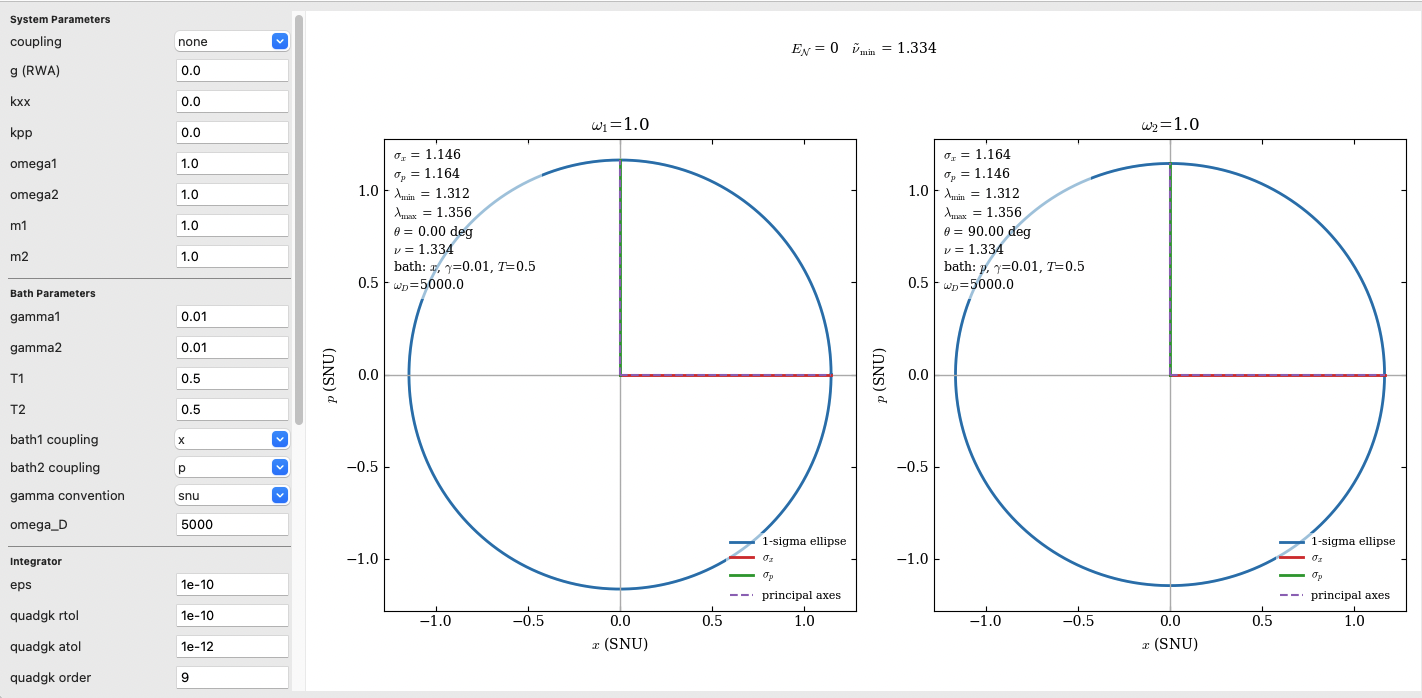
ABEE two-mode ellipse GUI
A GUI for steady-state covariances of two coupled light modes with NEGF diagnostics.
People
MSCA Cofund · Physics for Future · FZU
The DecEntQueSt fellowship is hosted at FZU and supported through the Physics for Future MSCA Cofund program.
Contact
Karol Kawa
Postdoctoral Fellow, Physics for Future MSCA Cofund at the Institute of Physics (FZU).
ORCID: 0000-0002-3846-7437